
On March 5th, Web3 developers, founders, and AI builders gathered at 42 Berlin’s x402 Ideathon, a hands-on event focused on exploring how programmable payments can unlock new economic models for services, APIs, and autonomous agents.
The event brought together 45 onsite participants, with teams forming throughout the day to experiment with ideas and early prototypes. By the end of the session, 15 teams presented their concepts, showcasing a range of approaches to embedding payments directly into digital interactions.
The Ideathon served as both an introduction to x402 and a preview of what developers can build when payments become part of the internet protocol itself. For readers new to the concept, we previously explored the broader vision behind x402 in our blog x402: Unlocking the agentic commerce era.
Builders interested in exploring or implementing the protocol for their own applications can also visit our x402 page, and our dev-focused x402 page provides an implementation walk-through.
The Ideathon used eight tracks, each exploring different ways programmable payments can reshape how digital services operate and monetize.
Micropayments: Real-time, fractional value
This track focused on applications that enable extremely small, real-time micro-payments using x402 on Algorand. Builders explored scenarios where traditional payment rails struggle, including pay-per-article content, streaming payments for APIs or compute, nano-transactions, and tipping.
Machine-to-machine payments: Autonomous value flows
This track explored systems where software, devices, or infrastructure components pay each other automatically. Examples included AI services paying for inference or data, infrastructure nodes settling payments between themselves, and SaaS components charging per request.
Agentic payments: AI agents that transact
Projects in this track explored how AI agents can initiate, authorize, and settle payments autonomously. Builders experimented with scenarios such as agents subscribing to services, executing trades, or negotiating and settling digital services on behalf of users.
Pay-as-you-go access: Metered premium resources
This track focused on replacing logins, API keys, and subscription systems with payment-based access control. Builders explored systems where payments unlock resources such as dataset queries, API calls, downloads, or compute cycles.
Subscriptions and renewals: Autonomous recurring payments
Participants explored how recurring payments can be executed programmatically by agents or smart accounts. Use cases included automated SaaS subscriptions, infrastructure renewals, and logic-driven service upgrades.
Pay-per-API call: Programmable monetization layer
This track focused on infrastructure that monetizes each API request directly. Instead of managing API keys, quotas, or centralized billing systems, services can embed payments directly into each request using x402.
OpenClaw/Claude Code agentic commerce
This track encouraged builders to create complete autonomous payment flows using OpenClaw or Claude Code. Projects focused on agents discovering paid services, funding wallets, executing requests, settling payments automatically, and continuing their workflows without interruption.
Security must be a key consideration, particularly when it comes to ensuring safe interactions between agents and services. Discussions around securing these automated processes and ensuring the integrity of transactions need to be integral to ensuring that these autonomous flows are not only efficient but also safe from potential vulnerabilities.
Open innovation: Beyond the defined tracks
The final category welcomed experimental ideas that did not clearly fit within the other tracks. Teams used this space to explore new financial primitives, cross-industry integrations, and developer tools that expand the possibilities of programmable payments.
Winning projects
At the end of the Ideathon, 15 teams presented their ideas, and three projects stood out for their clarity and practical approach to using x402. Feel free to check our tweet with the announcement here, and all the submissions on the Ideathon’s page.
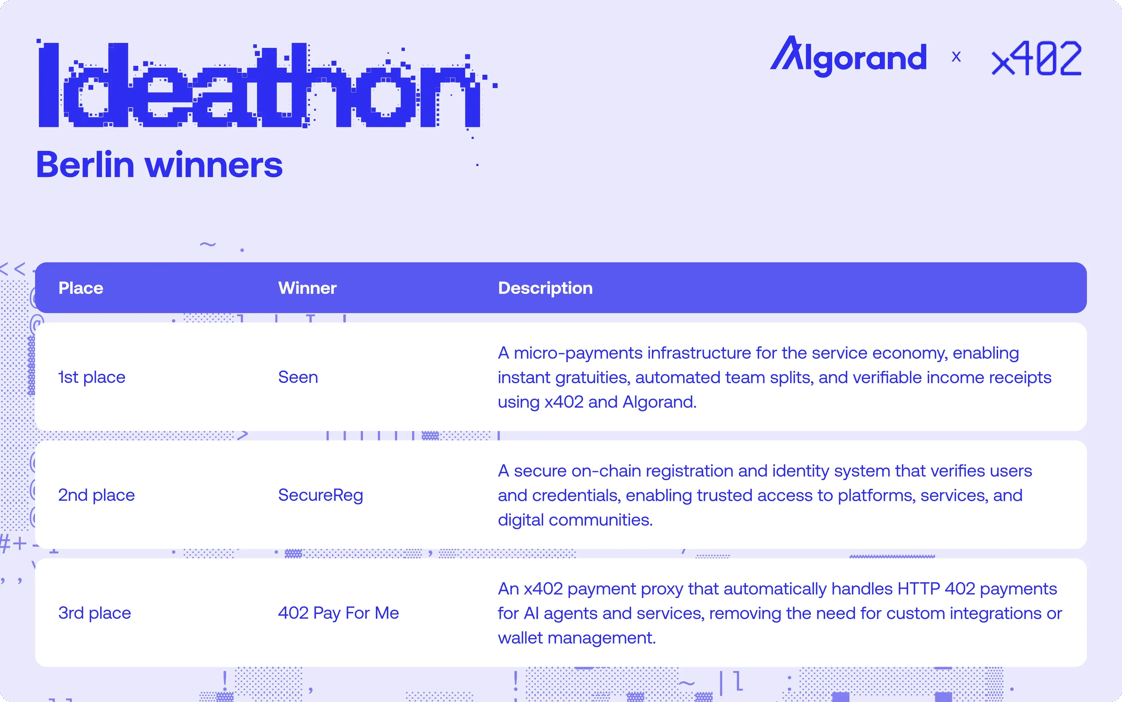
1st Place: Seen
https://dorahacks.io/buidl/40182
Seen proposed a micro-payments infrastructure for the service economy, enabling instant gratuities, automated team revenue splits, and verifiable income receipts using x402 and Algorand.
Prize: USD 500 plus USD 250 in AI credits from GoPlausible
2nd Place: SecureReg
https://dorahacks.io/buidl/40181
SecureReg introduced a secure on-chain registration and identity system that verifies users and credentials, enabling trusted access to platforms, services, and digital communities.
Prize: USD 300
3rd Place: 402 Pay For Me
https://dorahacks.io/buidl/40173
402 Pay For Me presented an x402 payment proxy that automatically handles HTTP 402 payments for AI agents and services, removing the need for custom wallet integrations or payment logic.
Prize: USD 200
Special thanks
A big thank you to 42 Berlin for providing an excellent venue and supporting the x402 Ideathon. Their commitment to fostering innovation and providing a space for developers to collaborate is invaluable to the success of events like this.
We’d also like to extend our appreciation to GoPlausible for sponsoring the event, providing mentoring and offering USD 250 in AI credits to the winning team. Their support plays a critical role in helping developers bring their ideas to life and advance the future of agentic commerce.
What comes next
The Berlin Ideathon demonstrated how quickly developers begin to rethink digital services once payments become part of the protocol layer.
Instead of managing subscriptions, API keys, and centralized billing systems, developers can design applications where value exchange happens automatically as part of each interaction.
The next opportunity to build on these ideas will be the Agentic Commerce Hackathon in Berlin from April 10 to April 12 for developers interested in programmable payments, AI agents, and autonomous services.
Register here today.
Learn more about Algorand and x402
x402 ecosystem on Algorand: Explore here.
Go Plausible x402 internet-native protocol for Algorand: See x402 in action.
Visit our dev resources page: Start building.
Blog overview of x402: Unlocking the agentic commerce era: Read the blog.
Algorand Agent Skills: Smarter AI for Algorand Development: Read the post.
Disclaimer: The content provided in this blog is for informational purposes only. The information is provided by the Algorand Foundation and while we strive to keep the information up-to-date and correct, we make no representations or warranties of any kind, express or implied, about the completeness, accuracy, reliability, suitability, or availability with respect to the blog or the information, products, services, or related graphics contained in the blog for any purpose. The content of this blog is not intended to be legal, financial, or investment advice nor is it an endorsement, guarantee, or investment recommendation. You should not take any action before conducting your own research or consulting with a qualified professional. Any reliance you place on such information is therefore strictly at your own risk. All companies are independent entities solely responsible for their operations, marketing, and compliance with applicable laws and regulations. In no event will Algorand Foundation nor any affiliates will be liable for any loss or damage including without limitation, indirect, or consequential loss or damage, or any loss or damage whatsoever arising from loss of data or profits arising out of, or in connection with, the use of this blog. Through this blog, you may be able to link to other websites which are not under the control of the Algorand Foundation. We have no control over the nature, content, and availability of those sites. The inclusion of any links does not imply a recommendation nor endorse the views expressed therein.