
Every time the internet has taken on a new kind of participant, it has exposed a payment rail that wasn't built for it. Card networks were built for a person standing at a register. They were stretched to cover a browser tab, and it worked, barely, with fraud tooling and checkout friction bolted on for decades. Agentic AI is the next participant, and it is not a person with a browser tab. It is software that can decide, in milliseconds, to call a hundred different paid services on someone's behalf, evaluate what came back, and call a hundred more. Nothing about the existing rails was built to carry that. The question worth asking isn't just whether agents can pay at all – x402 already answers that – it's which underlying chain should the payment settle on, because at agent scale, that choice stops being a footnote and starts being the constraint.
What agent-scale volume demands
A human making an online purchase generates one transaction and can tolerate a few seconds of uncertainty while it clears. An agent completing one task might generate dozens of transactions, a pricing lookup, a verification check, a compute call, a follow-up, each individually worth a fraction of a cent, each needing to clear before the agent's next decision depends on it. That shift changes what “good enough” looks like for a settlement layer. Three properties stop being nice-to-haves and start being requirements:
- Finality must be immediate and certain, not probable.
- Cost must stay negligible and predictable at extremely high transaction counts, not just cheap on a good day.
- And settlement must be independently verifiable, since the party on the other end of an agent-to-agent transaction usually isn't a human who can just call and ask what happened.
Finality: certain, not eventually certain
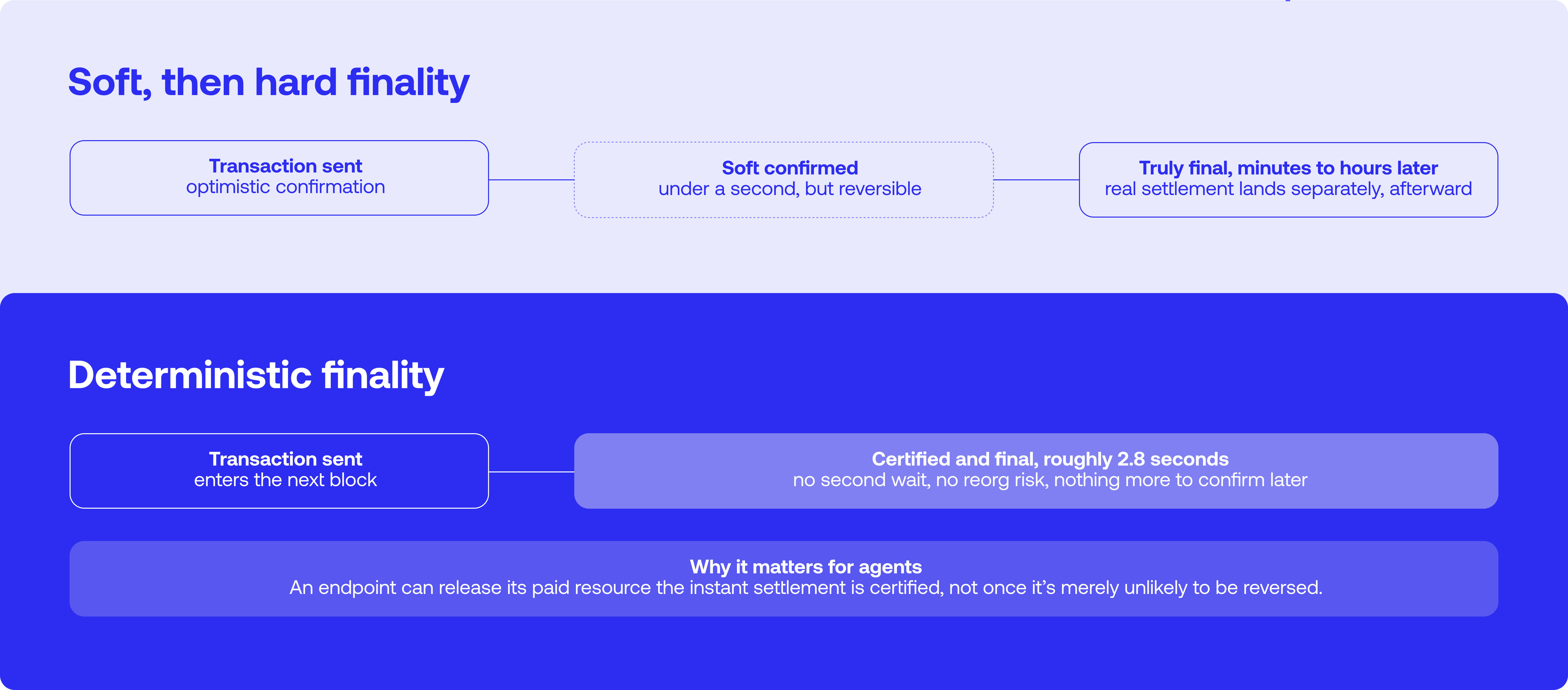
Most blockchains give you a transaction that's provisionally included and then becomes more final as more blocks are added on top of it, which is a reasonable trade-off for a lot of use cases, but it introduces a window where an outcome is probable rather than guaranteed. For an agent economy, that window is a real problem. If an endpoint has to wait for several confirmations before it can be sure a payment is settled, it either releases the paid resource on faith or adds latency back into a system whose whole value proposition was removing latency.
Algorand's Pure Proof-of-Stake consensus produces blocks that are final the moment they're certified, roughly every 2.8 seconds, with no probabilistic settling period and no reorganization risk once a block is confirmed. A transaction is either in a certified block, or it doesn't exist. That's a meaningfully different guarantee than “final after enough confirmations have piled up,” and it's the difference an x402 facilitator needs: an endpoint can release its resource the moment settlement is certified, not the moment it's statistically unlikely to be reversed.
Cost that stays predictable at volume
Cheap is easy to claim. Cheap and predictable under load is harder, and it's the property that matters once you're running millions of sub-cent transactions instead of thousands of dollar-sized ones. Many chains price transactions through an auction, gas fees that rise and fall with network demand, which is a fine model when a transaction is worth ten dollars and a fee spike costs you fifty cents. It's a broken model when the transaction itself is worth two cents and the fee occasionally exceeds the payment. Atomic, honestly priced micropayments only work if the cost of moving the money doesn't compete with the price of the thing being sold.
Algorand's fee model is flat rather than auction-based; a fixed fraction of a cent per transaction, with a network built to handle up to 10,000 transactions per second. That combination of fixed cost and high throughput headroom is what lets a builder price a reminder at two cents and a booking at five cents and actually keep the difference, instead of watching network conditions eat the margin on the smallest, most frequent actions, which are exactly the actions an agent economy runs the most of.
Settlement that doesn't require trusting a middle layer
The third requirement is easy to overlook because humans rarely need it: when something goes wrong, or when an audit needs to happen, or when a dispute needs resolving, someone needs to be able to independently verify what actually settled, without taking a sequencer's word for it or waiting on a rollup's fraud-proof window to close. Algorand's consensus produces a single, publicly verifiable ledger with deterministic finality by design, not a fast “soft” confirmation followed by a slower “real” one settling elsewhere later. For an agent economy that's going to need real accounting, which endpoint got paid, how much, for what, at what time, that distinction between one settlement and two staggered ones is not academic. It's the difference between a ledger you can point an auditor at and a ledger you have to explain.
What this means for what you build
None of the properties above matter in the abstract, they matter because of what they let a developer ship. If finality is instant and fees stay flat and negligible at volume, the right unit to build is not an application, it's an endpoint: one narrow, honestly priced capability that an agent can call, evaluate, and pay for in a single exchange. Four patterns cover most of what's worth building.
- Charge for data: sell access to a dataset, a report, a market signal, or a verification result, one request at a time.
- Charge for compute: let an agent pay only when it runs a model, executes code, or completes an inference call.
- Charge for actions: let an agent pay to trigger something real, sending a message, booking a resource, generating a file.
- Charge for verification: sell trust itself, proof, a reputation check, a validation an agent should run before it acts on someone's behalf.
What ties all four together is that they're cheap, frequent, and only worth building if the settlement layer underneath doesn't eat the margin or introduce a delay the agent must wait out. That's the specific reason the finality and fee properties described above aren't a side benefit, they're what makes the endpoint pattern viable at all.
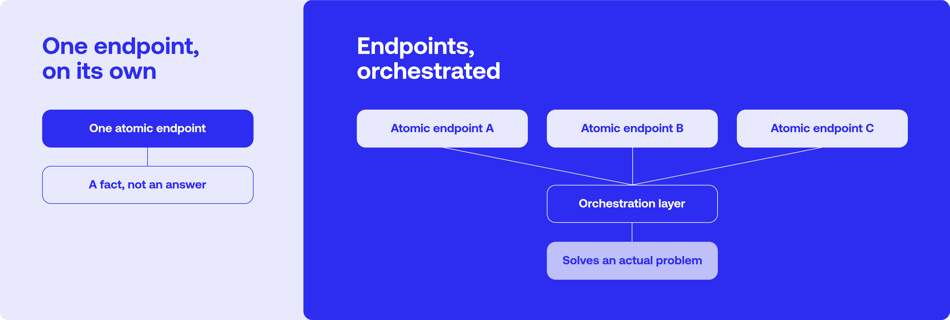
But an endpoint by itself rarely solves anything. A pricing lookup is a fact, not an answer. A single inference call is a capability, not a decision. Real utility, the kind someone actually keeps paying for, almost always comes from orchestration: taking several narrow, atomic endpoints, sometimes several you built yourself, sometimes several built by entirely different teams, and combining them into a response to a question a person or another agent actually had. The endpoint is the unit worth building. The solution is what you get when several of them work together toward a problem someone needs solved.
Poe, Quora's consolidated interface for chatting with several AI models through one product, is a useful case to look at here. This is not because anything about it is done wrong, but because its own published policies show clearly what a team has to build when the models it is bringing together don't have a native way to charge per use and settle right away. That infrastructure is a reasonable, well-built answer to a real constraint, and it is worth going through in some detail because of how differently the same product can look once that constraint is no longer there.
To let users move between models in one place, Poe has users prepay into a points balance, spread across fixed subscription tiers. Poe's own help center says unused points do not carry over between billing periods unless a plan says otherwise, and that points bought ahead of time expire one year after purchase (Poe Purchases FAQs). On the creator side, developers who build bots on the platform are paid on a periodic cycle rather than right away: Poe's Creator Monetization FAQ says earnings become payable once they reach ten dollars, with payment sent thirty to forty-five days after the end of the month they were earned in, routed through Stripe (Poe Creator Monetization FAQs). Building and keeping up that accounting, the points ledger, the subscription tiers, the payout calendar, is a fairly big piece of infrastructure sitting next to the actual product, and it is what any team has to build today when there is no settlement layer underneath that can charge and pay out per use, instantly.
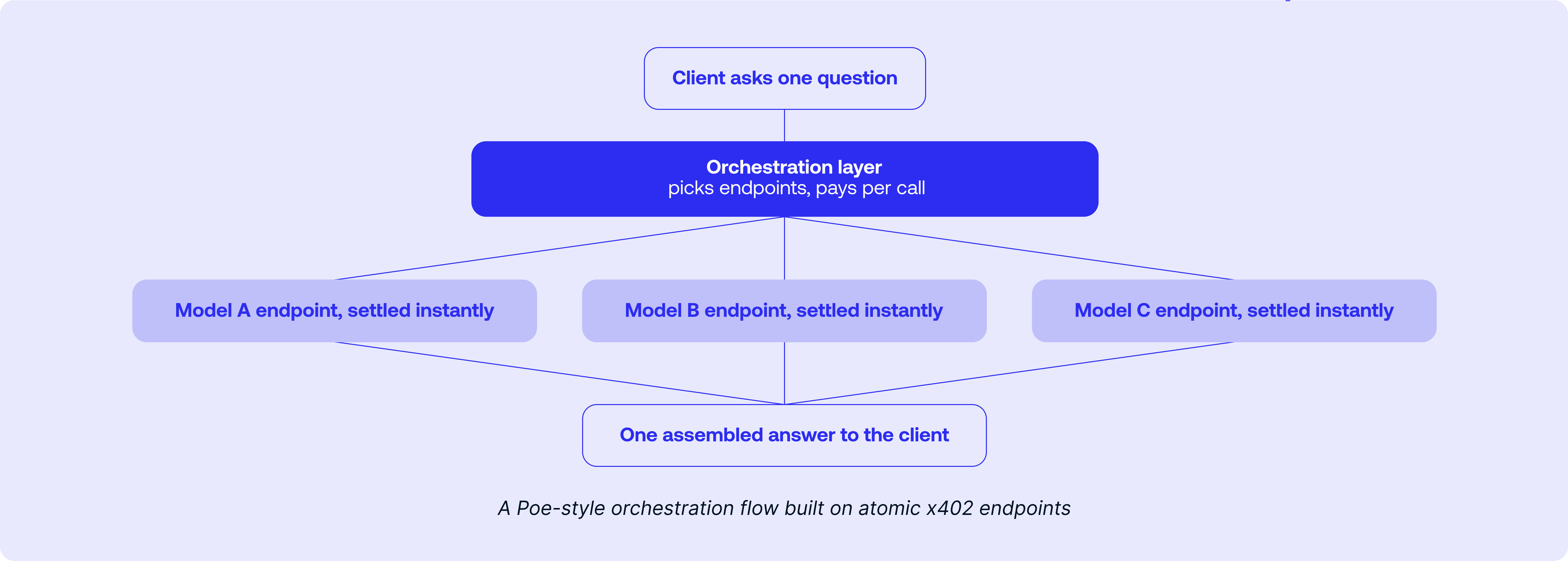
Now picture the same kind of product built the other way around: as an orchestration layer sitting on top of several atomic x402 endpoints, each one a separate model, priced and settled on its own. A client asks one question. The orchestration layer decides which endpoints that question actually needs, calls each of them, pays each one the moment it answers, and puts together what comes back into a single response. This version works out better for everyone involved, not only for the team building it: the aggregator does not need to build or maintain its own financial system on the side, the model providers behind each endpoint get paid the moment their work is used instead of waiting on a monthly cycle and a minimum threshold, and the end user never carries a prepaid balance that can sit there unused or quietly expire. None of that flow needs a points system or a payout calendar, because every leg of it settles by itself, in seconds, at a cost too small to matter. The product is the judgment applied in the middle, not the settlement machinery underneath it, and that is only possible because the settlement layer underneath can be trusted to just work, every time.
Now picture the same kind of product built the other way: as an orchestration layer sitting on top of several atomic x402 endpoints, each one a distinct model, priced and settled on its own. A client asks one question. The orchestration layer decides which endpoints the question needs, calls each one, pays each one individually the moment it responds, and assembles what comes back into a single answer. Nothing about that flow requires a points balance, a subscription tier, or a monthly payout run, because every leg of it settles on its own, in seconds, at a cost too small to matter. The product is the judgment applied in the middle, not the settlement machinery underneath it, and that's only possible because the settlement layer underneath can be trusted to just work.
This is the argument for building endpoints on Algorand: not that a single endpoint is valuable in isolation, but that instant, cheap, verifiable settlement is what makes it worthwhile to build several of them and let something else orchestrate them into a real solution. That's the concrete version of the abstract argument above: the difference between a builder having to construct financial infrastructure from scratch and a builder being able to skip that step entirely and just build the product.
Where this is already running
This isn't a hypothetical fit. Algorand added full x402 support on Mainnet in February 2026, with ecosystem startup GoPlausible operating a facilitator that verifies and settles payments natively on the Algorand Virtual Machine. Every one of the properties above, instant finality, flat low fees, single-ledger verifiability, is already what's carrying those settlements today, not a roadmap item.
It's also worth being honest about where the broader x402 ecosystem stands; daily transaction volume across the whole protocol, on every chain, is still small relative to the attention agentic commerce is getting, and a meaningful share of it is still test traffic and early experimentation rather than mature, sustained demand. That's not a weakness in the thesis; it's exactly why the base layer choice matters more right now than it will later. The rails get chosen while the volume is still forming, not after. Builders shipping x402-powered endpoints today, including through the Global x402 Challenge, are making that choice in real time, and the properties that matter at agent scale, certain finality, predictable cost, verifiable settlement, are the ones worth building on.
Disclaimer: The content provided in this blog is for informational purposes only. The information is provided by the Algorand Foundation and while we strive to keep the information up-to-date and correct, we make no representations or warranties of any kind, express or implied, about the completeness, accuracy, reliability, suitability, or availability with respect to the blog or the information, products, services, or related graphics contained in the blog for any purpose. The content of this blog is not intended to be legal, financial, or investment advice nor is it an endorsement, guarantee, or investment recommendation. You should not take any action before conducting your own research or consulting with a qualified professional. Any reliance you place on such information is therefore strictly at your own risk. All companies are independent entities solely responsible for their operations, marketing, and compliance with applicable laws and regulations. In no event will Algorand Foundation nor any affiliates be liable for any loss or damage including without limitation, indirect, or consequential loss or damage, or any loss or damage whatsoever arising from loss of data or profits arising out of, or in connection with, the use of this blog. Through this blog, you may be able to link to other websites which are not under the control of the Algorand Foundation. We have no control over the nature, content, and availability of those sites. The inclusion of any links does not imply a recommendation nor endorse the views expressed therein. Any statements about future plans, integrations, or protocol upgrades are forward-looking and subject to change.