
Algorand white papers & research
Driving innovation in post-quantum security, blockchain, and digital assets.
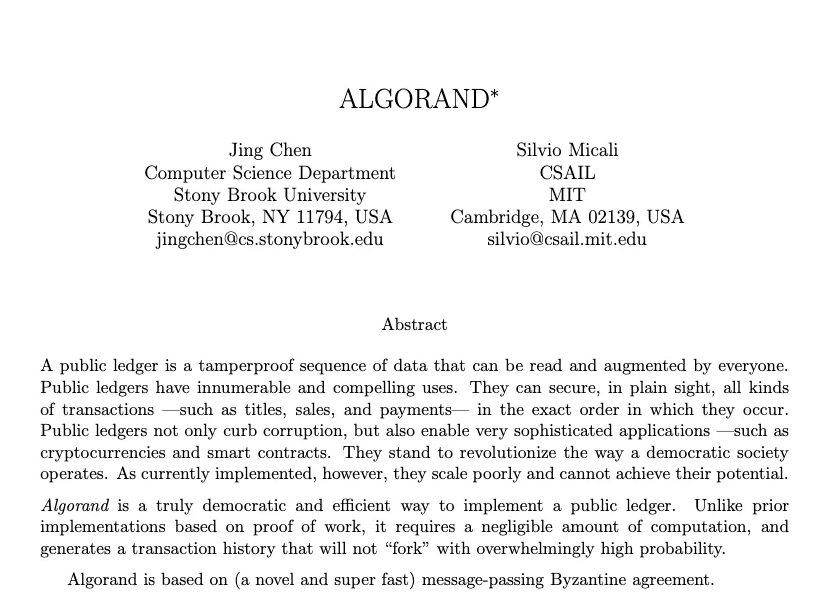
The Algorand whitepaper (May 2017)
-
Read about Algorand Post-Quantum Ledger (May 2026)
Algorand Post-Quantum Ledger (May 2026)
Securing the Algorand ledger, one account type at a time.
-
Read about Technical Brief: Quantum-resistant transactions on Algorand with Falcon signatures (November 2025)
Technical Brief: Quantum-resistant transactions on Algorand with Falcon signatures (November 2025)
How Algorand crafted its first post-quantum transaction, the technical architecture that made it possible, and what developers can do with the tools. Article explores Falcon’s cryptographic design, the logic signature verification flow, performance considerations, and the broader implications for blockchain security as quantum computing advances.
-
Read about Using Blockchain-Based Digital Identity and Verifiable Credentials for Chess (April 2025) (opens in a new tab)
Using Blockchain-Based Digital Identity and Verifiable Credentials for Chess (April 2025)
This paper conceptualizes a new system that utilizes blockchain to establish secure, portable digital identities and verifiable credentials for chess players everywhere. Utilizing standardized data models and decentralized identifiers (DID), the proposed system is secure and privacy-preserving. If adopted, it will allow chess players to independently manage their identity and credentials across chess platforms and organizations.
-
Read about Quantum Cryptanalysis of Subset-Sum Hashing (June 2023) (opens in a new tab)
Quantum Cryptanalysis of Subset-Sum Hashing (June 2023)
This paper presents an analysis of the quantum cryptanalysis of subset-sum hashing in the context of Algorand's sumhash512. It was initially prepared as an internal report and later made publicly available in response to a classical attack analysis.
-
Read about Proof of Stake Blockchain Efficiency Framework (April 2022) (opens in a new tab)
Proof of Stake Blockchain Efficiency Framework (April 2022)
This paper proposes a framework for the comparison of blockchain efficiency and sustainability that properly weighs the three essential elements of a blockchain’s purpose—security, scalability, and decentralization—into the resulting score.
-
Read about Achievable CCA2 Relaxation for Homomorphic Encryption (March 2022) (opens in a new tab)
Achievable CCA2 Relaxation for Homomorphic Encryption (March 2022)
This paper tackles a critical challenge in securing computations on encrypted data. Homomorphic encryption, while powerful, suffers from expensive "bootstrapping" processes to refresh ciphertexts. To address this, some explored client-aided outsourcing, where a client refreshes ciphertexts for a server performing computations. However, a key question remains: is this approach vulnerable to malicious servers?
-
Read about Subset-Sum Hash Specification (September 2021) (opens in a new tab)
Subset-Sum Hash Specification (September 2021)
This paper presents the specification of the Subset Sum Hash function, whose quantum-cryptanalysis has proven to have at least 128 bits of security against known quantum collision-finding attacks. This primitive is used by Algorand consensus to generate State Proofs.
-
Read about Can a Public Blockchain Keep a Secret? (September 2020) (opens in a new tab)
Can a Public Blockchain Keep a Secret? (September 2020)
This paper proposes a secure way to store secrets on a blockchain, along with specific instructions for their use. Imagine a secure vault that releases information only when certain conditions are met. This system is scalable and protects against a malicious actor controlling a portion of the system.
-
Read about Compact Certificates of Collective Knowledge (May 2020) (opens in a new tab)
Compact Certificates of Collective Knowledge (May 2020)
This paper introduces the concept of compact certificate schemes. These schemes enable any party to condense a large number of signatures on a message M, obtained from signers with different weights, into a significantly shorter certificate. This compressed certificate efficiently convinces verifiers that signers with a combined weight have indeed signed M.
-
Read about Practical Non-interactive Publicly Verifiable Secret Sharing with Thousands of Parties (October 2018) (opens in a new tab)
Practical Non-interactive Publicly Verifiable Secret Sharing with Thousands of Parties (October 2018)
This paper proposes a significant advancement in secret sharing for decentralized systems. Unlike previous solutions, this scheme caters to permissionless blockchains with massive committees, reaching thousands of participants.
-
Read about Algorand Agreement: Super Fast and Partition Resilient Byzantine Agreement (April 2018) (opens in a new tab)
Algorand Agreement: Super Fast and Partition Resilient Byzantine Agreement (April 2018)
This paper presents a novel Byzantine agreement protocol with leader election that operates efficiently without the need for synchronized clocks. With an honest majority exceeding two-thirds, the protocol achieves agreement in a constant number of steps when the elected leader is malicious and in just two steps when the leader is honest.
-
Read about Algorand: Scaling Byzantine Agreements for Cryptocurrencies (October 2017) (opens in a new tab)
Algorand: Scaling Byzantine Agreements for Cryptocurrencies (October 2017)
This paper introduces Algorand, a blockchain that revolutionizes transaction confirmation and scalability. Unlike other blockchains, Algorand achieves low-latency transaction confirmation on the order of seconds while catering to a large number of users. Algorand ensures that even in the presence of malicious users and temporary network partitions, all users have consistent views of confirmed transactions, eliminating the possibility of temporary forks.